


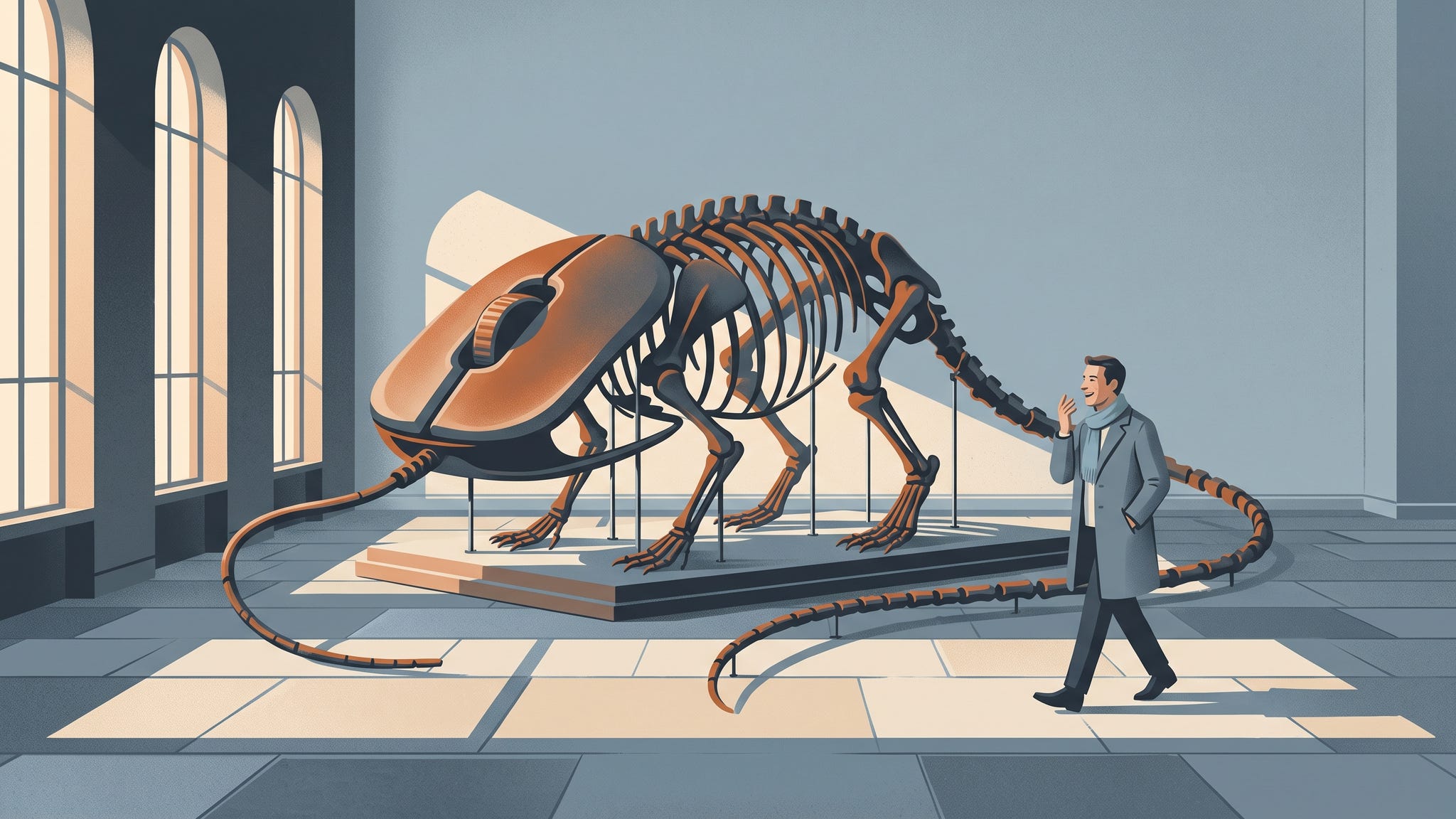
Whether you design software for a living, or your company serves its clients via a digital interface (and which doesn’t?), this piece will help you imagine the future.
First, let me go back a bit.
The graphical user interface has stuck with us since Steve Jobs and team, fresh from their visit to Xerox PARC, infused it into their 1984 Macintosh.
Its primitives were a huge leap in user experience and made computing accessible to the general public: the desktop, windows, buttons, menus and the mouse to command them all. That brilliance has given it a 42-year run so far.
As software grew more complex and capable, so did the GUI: side panels, nested menus, command bars, and an impossible-to-remember number of keyboard shortcuts were added, to serve power users.
That progression shaped software like Photoshop, AutoCAD, Blender or Microsoft Excel, and gave birth to professions where mastering the tool was, in practice, the job itself. With that, a whole industry of online courses, e-learning platforms and consultancies grew around it. Software training alone is worth around $80bn a year.
Then the smartphone form factor and the App Store brought a different kind of interface. One that increasingly captures the share of tasks done on the desktop.
People have come to love (some of) their apps. Not so much their desktop software or cluttered websites.
Now, AI is creating a new reality. One which the GUI as we know it might not survive.
The era of headless software
Much of the software is growing invisible. Or headless, as they call it in tech circles.
Agents are aggregating the functionality of utility software into a conversational interface, complemented with on-demand, interactive components that make the need for a dedicated UI for each task fade.
Modern agentic platforms combine natural language understanding, reasoning, web search, and, especially, the programmatic use of tools and third-party software. Frontier ones are getting better at full desktop software use too.
This collapses a bunch of software and apps into one single interaction platform.
You can argue that this is still the territory of power users, tech nerds and AI enthusiasts. Also that the experience isn’t optimal yet, and chat is a poor surface for many kinds of work. And you’d be right.
Yet you’d be missing the forest for the trees.
Automated requests now outnumber human ones on the web. Cloudflare says bots passed humans on HTML page requests in May 2026, more than a year ahead of its own forecast.
Quite clearly, people who use agents love not having to learn a new app to get something done.
And who are GUIs serving well anyway?
Unless you make a living as an After Effects wizard, and aside from the few mobile apps you like, most of the software you use daily takes mental energy that would arguably be better spent elsewhere.
Despite existing standards and shared primitives, using interfaces still requires muscle memory and some learning curve.
A combination of AI agents, new UI primitives and ambient computing might change how we interact with our digital products and services for good. Looking five years ahead, I don’t see fixed, deterministic GUIs surviving.
“No Browser Required! Our API is the UI” - Marc Benioff (founder of Salesforce), during the presentation of Headless 360
The interface the ‘84 Mac gave us, the one we’ve come to like (or is it tolerate?), may have been a 40-year necessary evil after all.
A mental framework for a new digital experience
So, what does the interface of the future look like?
Nobody really knows. This field is in its infancy and guessing its final shape is akin to predicting TikTok at the birth of the internet.
That doesn’t stop me from offering a mental framework: three principles and an approximation of where they lead. This is my best bet after dozens of conversations.
The digital experiences of the future will be outcome-first, adaptive and ambient.
1. Outcome-first
Despite all its goodness, the graphical user interface wasn’t a real leap from the command line. The user still had to know the right sequence of commands to get to a result or action. Those were abstracted away behind buttons, menus and windows, but the workflow remained.
LLMs and agents reverse this. A user states his intent, goals and constraints, and the agentic system works out the commands, actions and strategy. It surfaces only when a human decision, judgment or review is needed.
The right modality for this is not chat. At least, not only.
I believe the winner will be a combination of conversational capabilities, smart hints, dynamic UI and a multi-layered canvas.
To set intent - what the user wants done - conversation (written or spoken) is hard to beat. They can be as abstract or explicit, as general or detailed as they want or know how to be. It’s also the best primitive to resolve ambiguity and clarify directions.
It also allows people to explain themselves in the way they see reality. Formal, informal. Advanced or infant-level communication skills; all is understood and accepted.
Not everyone functions equally, though. Many users just prefer a direct, easy way to start, and refine it as they go.
This is where Quick Actions (shortcuts to the most common, frequently used or recent workflows), smart hints and autocomplete fit: at the start, where intent is set.
Some use cases work differently. Users may not know the full outcome upfront: a shopping site where customers find the items by looking at them, or a 3D marketplace where buyers browse models. Intent by discovery requires a different starting line, leading with a visual, spatial and dynamic UI, while still benefiting from conversational support.
While being a great modality to establish and refine intent, conversation is a poor modality for other parts of the flow: direct manipulation, edits, review and approval. Those need a different class of surface.
2. Adaptive
An example. Generating a high-quality image with one of the newest models is simple enough. Prompt and wait.
You get one or a few good images that roughly adhere to the concept you had in mind. Very rarely it produces THE image you wanted, in one shot.
From there, you either keep prompting for edits or make use of some kind of image editing surface. The first option is a proverbial pain in the ass. The second, well, depends.
ImageGen model developers and apps are already starting to offer new kinds of editing experiences. Combining selectors, text and recommended actions.
You can see a similar pattern in new-generation programming tools like Cursor and Claude Code. Which now allow you to select specific components of their generated outputs and request modifications.
While most user journeys don’t require such explicit editing options, this illustrates how chat is not good enough alone for the best experience.
Visual interface components will appear when and while useful. Then disappear, leaving room for the surface that makes the next step easier or more pleasant. They’ll adapt in size, level of detail and interactivity to the task and to the user.
The components themselves could be generated on the fly (Generative UI) or summoned from a library of premade, branded items, styled for the task at hand.
The latter is imminent: open standards already let agents call up such components inside a conversation. Fully generated UI, every pixel created at runtime, still takes a minute or two and sometimes breaks.
Picture a limitless canvas over which these components are summoned, adapted, used and discarded. Vertically on smartphones and small devices. Also horizontally on desktop.
It’s also multi-layered. You expand into a single component to unveil more tailored functions and views, then move up and down the stack as you wish, like navigating superposed dimensions.
The UI becomes ephemeral and focused on your outcome or next action. No sequences, no navigation.
3. Ambient
What made OpenClaw, precursor of the personal-agent category, feel “magical” was its ability to anticipate your needs. It made you feel it just “got you”, and it grew more useful the more you used it.
It did this with a mix of heartbeats (scheduled check-ins), scripts, unrestricted access to your files and software, and an elaborate (also wildly inefficient) memory system.
That made it come across as a true assistant that understood your context through several dimensions, and acted proactively unprompted.
It pinged you about a time-sensitive email you’d missed and drafted the reply unasked.
The new personal agents from labs and startups, such as Meta’s Muse and Instinct (whose pitch is that “there are no new interfaces”), do some version of this. They need far less technical skill, and each runs on its own sandboxed computer.
New digital experiences will carry a domain-specific version of this.
Your banking app (if we still call it that) will contain your personal banking agent. It will hold and grow a memory of your interactions, adapt offers to you and communicate contextually using your preferred tone. It will wake up when your phone says you’re at an airport store where your card gets you a benefit. If you use the benefit, it remembers. If you don’t, it remembers that too.
Done badly, that’s creepy: Pieter Levels already finds proactive “background push stuff” annoying unless the agent is “really superintelligent”. Done well, it’s the most attentive service your clients have had.
It will be mostly invisible, but deeply aware.
Agent of whom?

Everything above assumes that you and your company retain control over the discovery and the digital user experience. That you still own the window to your products and services. That is debatable.
Depending on what you offer, it is perfectly plausible that your product or service ends up being used not by your customer directly, but by his agent.
That creates a second category of customers. Your human ones and their agents. To the humans served that way, you become headless.
With the right business model and strategy, this may be perfectly fine. Agents don’t need seats, so it probably means charging for work done and making sure yours is the product the agent picks.
And whose agent will it be? Pieter Levels sees the labs’ assistants “cannibalizing everything that used to be apps”. Bernat Farrero, co-founder of Factorial, bets the other way: each company will build its own AI-native interface on top of the system that holds its data.
If you could use some help in figuring this all out: the right interface primitives, agent strategy and business model, get in touch. At the VCA AI Labs, we invest a lot of our time working and thinking about this.
See you next week!