


Claude Opus 4.6 is already better than most humans at most knowledge work. I am not as intensive a user of the other frontier models but I assume they are too.
This is especially true when packaged in a product like Cowork and Claude Code, and when complemented with skills, plugins, subagents and connectors.
Assuming this statement is true, why is AI not adding trillions of dollars to the global GDP?
Now, the top percentile of professionals is still better than Claude at what they do. But, by definition, most humans are not in the top percentile of their profession.
Also, there will always be an elusive group of activities in which the best models are not yet competent out-of-the-box. For example, those requiring visual taste and design skills or require complementary technologies to advance further (eg. those that have a physical nature and advanced robotics to catch up).
Apart from these, the answer to the question may live in three factors: diffusion, coordination and trace
Diffusion
Dario Amodei, Anthropic’s CEO, hinted in a recent interview at diffusion being the key drag for the AI generation of real and massive enterprise value.
Diffusion, or time-to-diffusion, may be defined in this context as the time it takes for a working tech that would generate obvious productivity gains to be effectively adopted by organizations and institutions.
In other words, while individuals and startups adopt AI tools almost immediately, enterprises lag despite the obvious productivity gains. In his own words, a piece of tech like Claude Code is extremely easy to set up, yet large enterprises adopt it “many months slower”.
Legal reviews, security compliance, procurement, provisioning. These are friction points he cites that persist even with compelling AI products. The “country of geniuses in a data center” wouldn’t instantly transform the economy.
He’s right. I see it every day.
But the drag may be more human than he suggests.
Awareness: Most executives and managers don’t even really know these capabilities exist. Best-case scenario, they might have discussed it in their steercos and board meetings. They may have heard about Codex, Cowork and Langchain from an adept employee or their consultant of choice. But they don’t really know it. They haven’t really seen it work. They haven’t felt it. Even if they say they do, they don’t.
Not too many people have dangerously-skipped-permissions on Claude Code and seen it one-shot a complex feature or an entire web app. Very few have observed how Cowork creates a rather complex financial model with only a decent briefing. Even less have set up a squad of agents on OpenClaw, ever heard about Conductor to orchestrate several agents or know about the existence of companies like Sierra.
The gap between “I’ve heard of AI” and “I’ve seen what it does” is enormous.
This is not an executive problem. It’s a generally human one. The chart below has circulated for a couple of weeks now but still illustrates it beautifully.
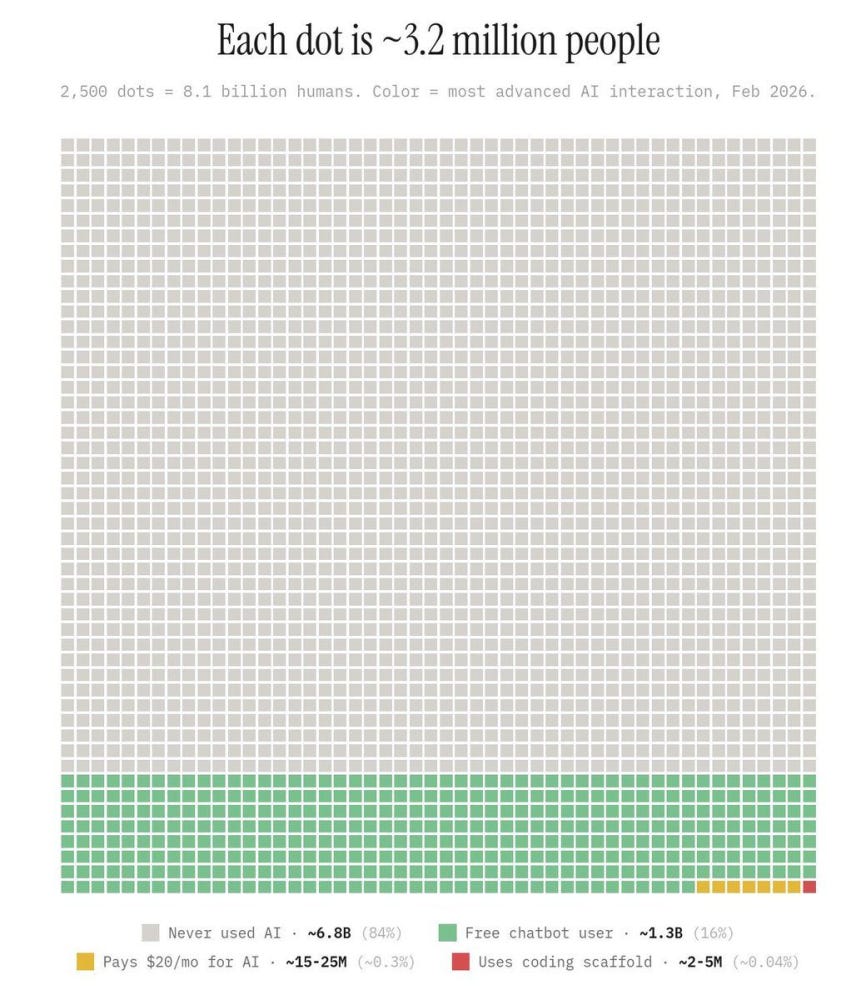
If you are not truly aware of the capabilities of something, how are you supposed to make the case for it? Present it, vouch for it, push it forward. This alone may be the single most important factor for the diffusion lag.
Focus: Once you have awareness on the power of AI you still need the bandwidth and time to explore it. To play with it. Test it, mess up and start again.
Even if you have talented and passionate individuals in your organization who may make waves with the tech, they just can’t handle it because they lack the space and focus. Sad yet extremely frequent.
Incentives: Depending on the size, type of activities and dynamics a specific group has, they might just not be incentivized to truly insert AI into their work. Especially if they have the slightest hint of the true capabilities of the best frontier models. Especially around technology teams.
News like the recent Amazon layoffs on their Prime Video and Twitch divisions don’t make the case easier.
“Show me the incentive and I’ll show you the outcome.” - Charlie Munger
Individuals and teams need to feel secure and empowered to be encouraged to adopt and deeply integrate the technology. The mere suspicion they are not, and the organization will have a very hard time making the best of it.
Coordination
Put simply, a job can be thought of as a combination of tasks plus coordination activities. Tasks can be simple or complex, tactical, operational or executive (e.g., making a hiring decision IS a task). They are the core of a professional role.
Coordination are those activities that are done to effectively accomplish tasks, individually or in a collective (e.g., a company). Think meetings, email, standups, watercooler conversations and Slack chats but also status reports, project trackers, project management materials, kanban boards and an innumerable amount of tools.
Humans spend an inordinate amount of time on coordination activities. To the point that it is an industry on its own and entire roles are dedicated exclusively to it (e.g., PMOs, scrum masters, etc.).
Research shows that knowledge workers spend roughly 60% of their time on coordination overhead. Just, crazy. A 60% tax.
According to Asana’s Anatomy of Work Index, 60% of a person’s time at work is spent on work about work and not on skilled work
Although most professionals would much rather invest their time in actual tasks and excessive coordination rituals receive a fair amount of hate, some of it will always be necessary to accomplish worthwhile endeavors involving more than one person.
The deployment of AI tools and agentic workflows within the enterprise adds new coordination layers to the stack while changing current ones entirely:
Agent to human → How does a customer service voice agent summarize progress and/or escalate interactions effectively? What is the right format and cadence to evaluate effectiveness and accuracy?
Human to agent → Given an agentic workflow that monitors customer behavior and contextually communicates with him, how does a digital marketing manager track and steer its behavior?
Agent to agent → How do multi-agent systems hand off tasks among agents? What is the most effective architecture for latency, accuracy and costs? Can it replace entire human coordination pipelines entirely?
This symbiosis between humans and agents is not solved and still requires deliberate thought to do effectively. The chatbot paradigm in AI is so sticky because coordination is organically part of the product.
Agent to agent coordination is an ocean of opportunity. Improving it across different use cases and tech stacks is probably going to mint millionaires around it.
For companies thinking about how to deeply integrate AI in their business processes, coordination is a fundamental question without a standard answer. Human in the loop is no longer the only paradigm to think about. Human parallel to the loop, after the loop or outside the loop might be considered too for specific use cases.
This is just not yet in their mental frameworks.
Traces
In my last post I argued that our ability to encode expertise in language is a bottleneck for AI value creation. That’s true. But it’s not the whole story.
Encoding the skills and procedures is fundamental. Scalable access to data and rules, a must. But to be truly effective, agents need something else: decision traces.
The decision traces – the exceptions, overrides, precedents, and cross-system context that currently live in Slack threads, deal desk conversations, escalation calls, and people’s heads. - Jaya Gupta
(Related to the previous point, many decision traces originate from coordination activities.)
Real-world work is full of ambiguity. That ambiguity is solved by humans through memory of precedents, organizational understanding and synthesis among systems and off-system discussions. But AI agents don’t have access to those traces on a database or system of record.
This connects directly to coordination. Many decision traces originate there — in the meetings, threads, and calls that surround actual work.
Jaya Gupta wrote a brilliant piece about this on X. He calls the structures formed by accumulated traces context graphs. Beautiful. I won’t try to improve on it. Go read the original.
It is so good I don’t see expanding on this point myself worth it. Nor would I do it justice. Go ahead and read the OG.
That’s it for this week.
Next, I’ll dig into what we can actually do about each of these three drags — diffusion, coordination, and trace. One post each.