



In August this year, the famous investor Stan Druckenmiller published an op-ed in the Wall Street Journal criticizing the decision of the US Treasury Secretary (his former mentee) to increase government buybacks of bonds.
Once published, several people ran the article through Pangram, arguably the top AI-detection tool for writing. An action that is today becoming a habit in the virtuous circles of intellectual vigilantes across the web.
The score came back at 100%. Fully AI-generated.
Druckenmiller’s response was blunt: “Of course I used AI.”
“I’m not embarrassed by it. [...] I write everything using AI now for the same reason I use a calculator when I do math problems. [...] My name is on the piece. It’s my message.”
The WSJ essentially backed him up: “The question for us is whether what we publish from contributors reflects an author’s original argument, and if the author has the standing and credibility to make it.”
Neither of these, nor the fact that he was defending ideas he has espoused for years, appealed to the critics. It became, within an already growing trend, the latest and greatest instance of AI-shaming.
The economic arguments of the piece don’t matter much here. What happened next does. A display of the new dynamics, powered by AI detectors, that make our Internet a bit worse.
A new wave of virtue signaling
If you ever wandered through the comments section of any social media platform (or any community-based software, really), you will have noticed a good mixture of hate and virtue signaling. The weapons used vary and evolve with the trends of the time, but the spirit is there.
Lately, A favorite hobby among these groups is to hunt for AI slop and, when found, publicly shame the perpetrator in an attempt to undermine his authority and career. AI-spotting has become a hot thing.
It doesn’t matter if the ideas and arguments are the author’s, nor the amount of effort that went into actually “using AI” for the output to form. Nor the amount of editing or reframing afterwards.
It is perfectly possible for an article like Druckenmiller’s to be built upon sets of instructions - written or spoken - much longer than the piece itself. Also likely that it required a non-trivial amount of back and forth to reach its final shape.
What “AI writing” means is, at best, nebulous.
Is it just the generation of the words? The construction of the sentences? Do proofreading and editing also count? What about the research and storyline creation?
At worst, it is a slider in which - to one reader - a 32% score may seem acceptable while to others would seem outrageous.
It is also unclear why using LLMs to produce something is different from photographers leveraging Photoshop to improve their work, designers using Blender for 3D creations or investment bankers using Excel to create financial models.
Someone can have an original, sophisticated argument without possessing the writing skills needed to communicate it persuasively. If AI can help cross that bridge effectively, why not use it to do so.
Although... this may have a different angle too. Read on.
What detectors score
AI detectors now work well. A recent study found that false positives are rare when using the four major software tools. Pangram caught the spectrum of Human-AI very accurately.
But the job they do is a narrow one: they can tell whether a model produced the words and constructed the sentences. How much a machine touched the text. No more, no less.
Well, kinda. They can still be tricked through extensive prompting and about 30x more in token spending. Someone motivated enough can still bypass them in a couple of hours.
In any case, they don’t (and can’t) measure the quality of the ideas, the care involved in creating it or whether the text is worth reading at all.
Whose work is it?
The definition of authorship is clearly changing.
Until recently, the author of a piece of work was the one who did the thinking, the production, and was accountable for the output. In the case of writing, we are entering a phase in which intellectual contribution and textual production are no longer assumed to go together.
These can now be done by different actors and a more evolved framework to understand ownership it is required. We could now decouple authorship in three dimensions:
Intellectual authorship: who thought of and developed the underlying ideas and framing.
Linguistic creation: who put the words together and formulated the sentences.
Editorial accountability: Who stands behind the argument? Who verified the facts and approved the output?
There is a substantial difference between using an AI tool to translate your thinking into words and using it to produce the ideas that you present as your own. Both require accountability in their own way.
Writing is thinking
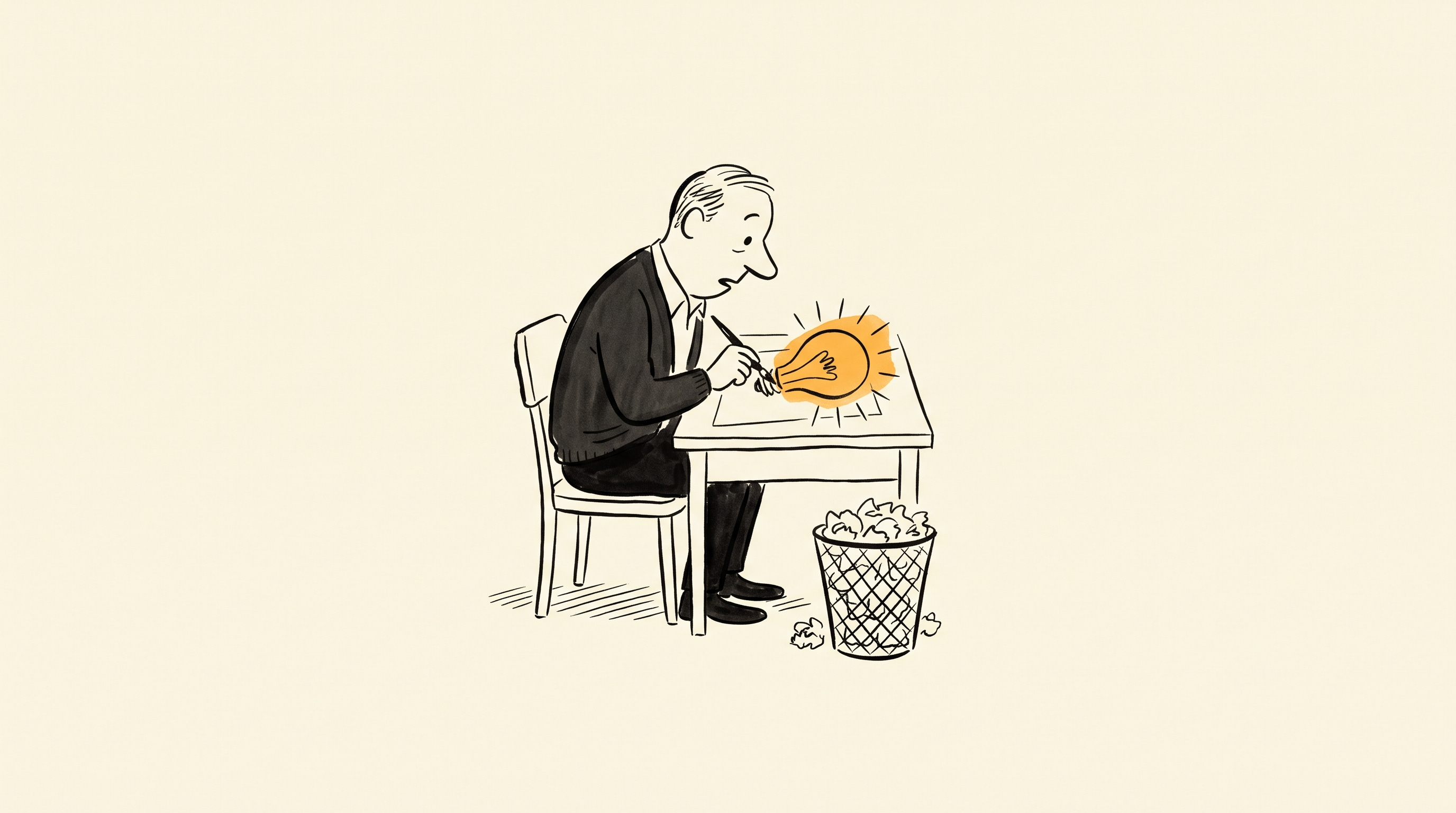
There is a group that makes a more robust argument against writing with AI. The most prominent of whom includes Paul Graham: “writing is thinking. In fact there’s a kind of thinking that can only be done by writing.”
And Emma Smith, an English professor at Oxford University: “You only really know what you think by writing it.”
The logic is sound. If you delegate fully the painful process of sketching your ideas, you outsource the process that requires the reasoning, judgment and tribulation to form them.
Writing is where you crystallize whether your thinking makes sense at all. Or whether it is too abstract or excessively narrow, or your points conflict.
I agree with that framing. In fact, while I use AI during the writing process (research, fact-checking, editorial review, grammar and orthography checks), I barely use it for the writing in itself.
But certainly, it is not the ONLY way of thinking. And certainly, not the only good way to write.
In cases like the WSJ op-ed, the thinking was already done. For years. Some version of it is public in interviews and podcasts. It just needed to be converted into words.
Some people just don’t enjoy the process of writing. Most are pretty terrible at it anyway. As long as the ideas are there, why not leverage tech to put them out in a clear way?
There are many disciplines and areas in which clarity is all: customer service, technical manuals, corporate memos, press releases or medical reports, for example. In economy op-eds too, if you ask me.
Current LLMs are great at clarity and I see no reason why they shouldn’t be extensively leveraged to produce faster and better versions of them (much like code, most prose produced by humans is not very good).
My best takeaway is to just stop scanning and, instead, ask: Is this worthy and interesting? Whose ideas and arguments are these? And who answers for them?